The Super Nintendo was released in 1990 and discontinued in 2003. In that thirteen-year window it produced a library of games that has never been matched for consistency, creativity or the sheer density of titles that remain genuinely excellent to play today — not as historical curiosities, not as nostalgia objects, but as games.
This is not a comprehensive list of every great SNES game ever made. It is a more specific argument: these are the games from that library that are not just good for their time but good full stop. Games that, if you sat down with them tonight having never played them before, you would finish.
🍄 Super Mario World (1990)
The launch title that set the standard for everything that followed. Super Mario World is the game that proved the SNES was a generational leap — not just more power but more possibility. The cape. Yoshi. The overworld map that made the game feel like a place rather than a sequence of levels. The secret exits that rewarded exploration without punishing you for missing them.
Thirty-six years later it remains the most perfectly balanced platformer ever made. Not the most ambitious, not the most spectacular — the most balanced. Every mechanic earns its place. Nothing is wasted. The difficulty curve is so natural that you barely notice it happening.
Why it still holds up: The controls are as responsive as anything released in 2026. The level design has never been bettered. There is no version of this game that isn’t worth playing.
🦍 Donkey Kong Country (1994)
The game that silenced everyone who said the SNES couldn’t compete with the new generation of hardware. Rare’s pre-rendered 3D graphics — achieved by rendering models on Silicon Graphics workstations and converting them to sprites — looked like nothing else on the market and created a visual style that is still immediately distinctive today.
But the graphics were always the secondary achievement. The primary achievement was the feel — the weight of Kong as he rolls, the momentum of Diddy as he bounces, the rhythm of a well-played level that turns into something closer to music than gaming.
The 2025 Donkey Kong Country Returns HD for Nintendo Switch is the definitive way to play this series today — the original games rebuilt and sharpened for a modern display, with the feel intact and the nostalgia multiplied.
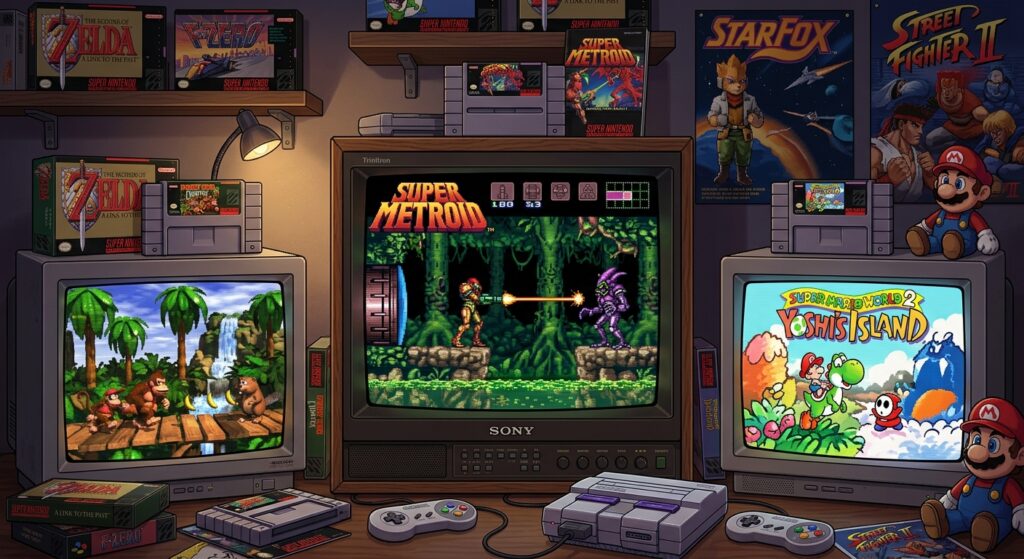
🚀 Super Metroid (1994)
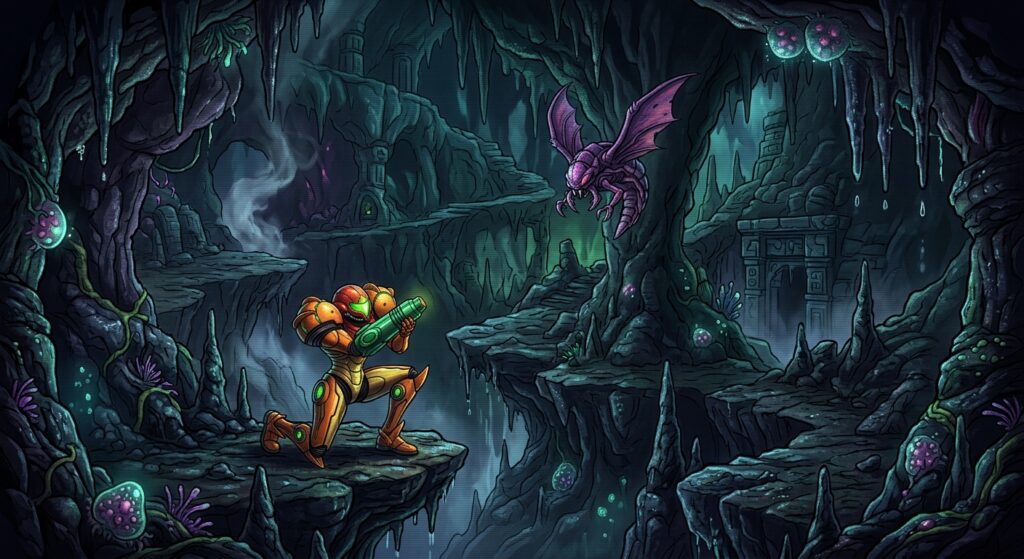
The most atmospheric game the SNES ever produced. Super Metroid drops you on the planet Zebes with minimal instruction and maximum environment — a world that communicates everything through design rather than text, that rewards attention and punishes carelessness, that creates a sense of genuine isolation that no game before it had achieved at that scale.
The Metroidvania genre takes its name partly from this game, and playing it today you understand why. The interconnected map, the backtracking that reveals new paths through old areas, the slow accumulation of abilities that recontextualises everything you’ve already seen — these were radical ideas in 1994 and they remain the blueprint for an entire genre of modern games.
Super Metroid is not easy. It is not forgiving. It expects you to pay attention and remember what you’ve seen. In an era of objective markers and waypoints, that expectation feels almost confrontational. It is also completely correct.
🦕 Super Mario World 2: Yoshi’s Island (1995)
The argument for this game is simple: it is the most beautiful 2D game ever made.
Not the most technically impressive. Not the most complex. The most beautiful — in the specific sense of a game that looks exactly the way it was intended to look, that has a visual identity so coherent and so fully realised that every frame of it is immediately recognisable thirty years later.
The crayon-and-watercolour aesthetic was a deliberate response to the pre-rendered CGI trend that Donkey Kong Country had popularised. Shigeru Miyamoto and his team chose to go in the opposite direction — handmade, organic, warm. The result is a game that looks like a child’s drawing come to life in the most affectionate possible interpretation of that phrase.
The gameplay is equally distinctive. Playing as Yoshi protecting baby Mario, you have a mechanic — the ability to transform swallowed enemies into eggs and throw them — that creates a different rhythm from any other platformer. Patient, deliberate, exploratory. Yoshi’s Island rewards completionists in a way that few games of its era did.
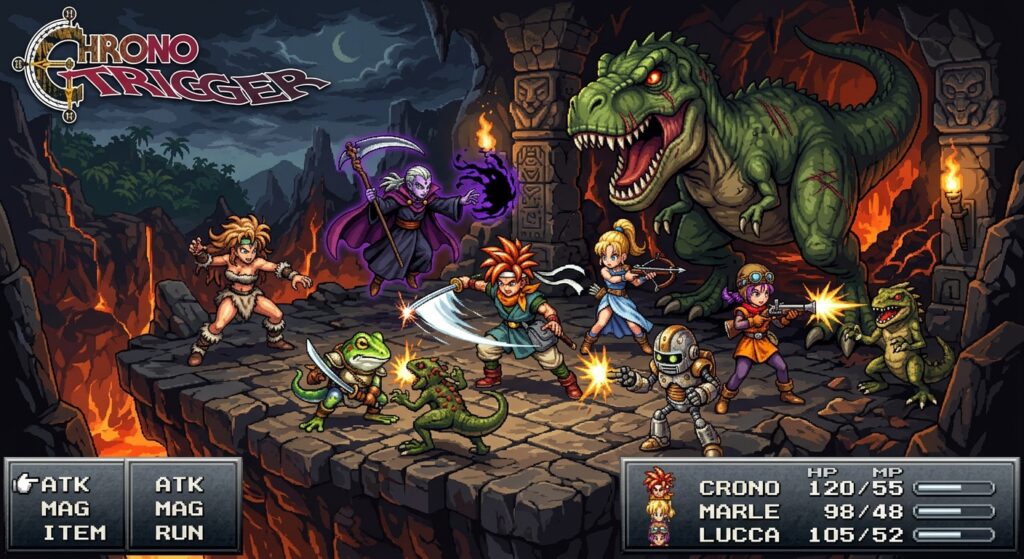
🎵 Chrono Trigger (1995)
Possibly the finest JRPG ever made. Chrono Trigger was developed by the «Dream Team» — Hironobu Sakaguchi, creator of Final Fantasy; Yuji Horii, creator of Dragon Quest; and Akira Toriyama, creator of Dragon Ball — and it shows. The game has the production values, the ambition and the emotional intelligence of three legends operating at the peak of their powers simultaneously.
The time travel mechanic is the structural achievement. Moving between different eras of a single world, watching your actions in one period affect another, discovering how the same locations look across centuries — it creates a coherence and a sense of consequence that most RPGs still struggle to match.
The ending — or rather the thirteen different endings — sealed its reputation. A game that rewarded replay in 1995 was ahead of its time. A game with thirteen distinct conclusions based on when and how you completed it was extraordinary.
🍄 Super Mario RPG: Legend of the Seven Stars (1996)
The last first-party Nintendo game released for the SNES in North America, and one of the most surprising. Super Mario RPG was developed by Square — the company behind Final Fantasy — and represents a collision of two universes that should not have worked and worked completely.
It took the Mario characters and world and applied turn-based RPG mechanics to them with a lightness and humour that Square’s own RPGs at the time rarely achieved. The result was a game that was simultaneously accessible to people who had never played an RPG and genuinely deep for people who had.
The 2023 Nintendo Switch remake is the definitive version — rebuilt visuals, arranged soundtrack, quality-of-life improvements that modernise without compromising. If you played the original and remember loving it, the remake will confirm that your memory was right. If you never played it, the remake is the reason to start.
🎮 The Legend of Zelda: A Link to the Past (1991)
The game that defined what a Zelda game is. A Link to the Past established every structural convention that the series still follows — the dual-world mechanic, the progression through dungeons that each introduce a new item, the overworld that opens progressively as you gain new abilities, the balance between exploration and direction that makes the game feel both guided and free.
It is also the most replayable entry in the series. Short enough to complete in a weekend, rich enough that returning players still discover things they missed. The Light World and Dark World create a map that doubles back on itself in ways that feel simultaneously logical and surprising, and the pacing — from the opening rain-soaked castle to the final confrontation — is as close to perfect as game design gets.
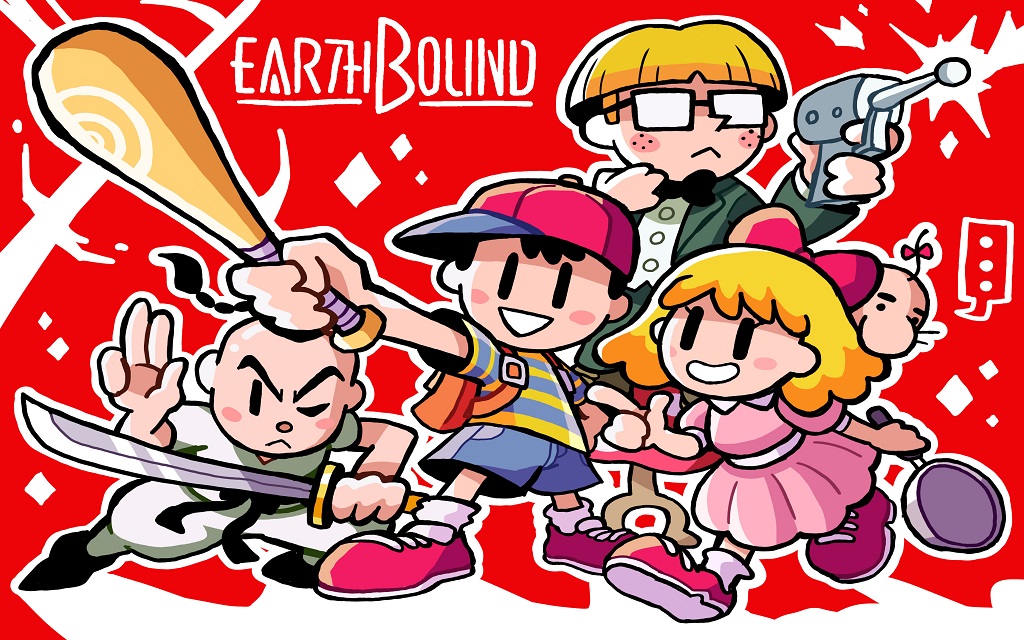
🌍 Earthbound (1994)
The strangest game on this list and possibly the most important. Earthbound — known as Mother 2 in Japan — is a JRPG set in a version of 1990s suburban America that feels simultaneously familiar and deeply wrong. Your weapon is a baseball bat. Your enemies are abstract shapes and possessed cars and New Age hippies. The final boss is a cosmic horror that you defeat by praying.
Shigesato Itoi’s game is genuinely funny in a way that few games have managed before or since, and genuinely moving in a way that sneaks up on you precisely because the funny is doing such effective cover work. By the time it asks something real of you, emotionally, you are completely unprepared.
Earthbound was a commercial failure in North America on its original release and became a cult object over the following decade. The people who found it felt like they’d discovered a secret. In a real sense, they had.
🎮 Play Them All — With the Right Controller
All of these games are available today via Nintendo Switch Online’s SNES library. The experience is significantly better with a controller that matches the original feel — the button layout, the resistance, the satisfying click of a well-made d-pad.
🎩 Bonus: Cuphead — The Game the SNES Would Have Made
Cuphead is not a SNES game. It came out in 2017 and runs on Unity. But it belongs on this list because it understands, at a fundamental level, what made the best SNES games great — the precision, the difficulty curve that respects the player, the visual identity so coherent that every frame is immediately recognisable.
Studio MDHR built Cuphead with hand-drawn 1930s cartoon animation and music recorded live by a jazz band. The result is a game that feels like a discovered artefact from a parallel timeline where the golden age of cartoons and the golden age of gaming converged.
And now, in 2026, Studio MDHR has announced Mighty Cuphead Adventure — a new spin-off programmed in Assembly Language to the exact specifications of the Sega Master System, complete with a real physical cartridge for the original hardware. A game so authentically retro that it requires the actual retro console to run it properly.
If that announcement does not make you feel something, you may want to check your pulse.
The Switch physical edition — published by iam8bit — is the way to own the original Cuphead properly. A cartridge. A box. The real thing.
What These Games Have in Common
Looking at this list as a whole, a pattern emerges that explains why these specific games still hold up when so many of their contemporaries don’t.
None of them rely on spectacle. The SNES was technically impressive for its time but its successor — the PlayStation — made it look dated within a year. The games that survived the hardware transition are the ones whose appeal was never primarily visual. Super Metroid isn’t great because of how it looks. Chrono Trigger isn’t great because of its graphics. Earthbound isn’t great because it was technically advanced.
They are great because of design — the arrangement of mechanics, challenges and moments that create an experience that is difficult to articulate and impossible to replicate by accident. Good game design does not age. It simply continues to be good design, in the same way that good writing and good music and good architecture continue to be good long after the context that produced them has changed.
The SNES produced more good design per year, per title, per megabyte of ROM, than any other platform before or since. That is the real argument for it. Not the nostalgia — the craft.
❓ Frequently Asked Questions
Yes — Nintendo Switch Online includes a growing SNES library accessible with a Nintendo Switch Online subscription. Many SNES classics are also available as individual purchases on the Switch eShop. For the most authentic experience, original hardware with a quality upscaler remains the gold standard.
Chrono Trigger and Super Metroid are the two games that appear on every serious list. Super Mario World is the most accessible and arguably the most perfectly designed. The honest answer is that the SNES library is deep enough that the best game depends entirely on what you value — platforming, RPG, atmosphere, exploration.
In spirit, yes. Cuphead shares the precision difficulty, the tight controls and the visual identity of the best SNES-era games even though it was released in 2017. Studio MDHR’s Mighty Cuphead Adventure, announced in 2026, takes this further — it is programmed in Assembly Language specifically for the Sega Master System hardware, with a real physical cartridge available for the original console.
Because the best ones were built on design rather than spectacle. When a game’s appeal relies on graphics or technical impressiveness, it ages with the hardware. When it relies on mechanics, level design and feel — as the best SNES games do — it remains as good as it ever was regardless of when you play it.
Nintendo Switch Online subscribers have access to a library that includes Super Mario World, Super Metroid, Yoshi’s Island, A Link to the Past, Donkey Kong Country, Earthbound, Chrono Trigger and many others. Super Mario RPG is available as a standalone remake. The library continues to expand.
🏁 One Last Thing
The SNES was not a perfect console. It had a small colour palette, a slow processor, games that cost more than they should, and a library that took time to find its identity.
What it had, in abundance, was people who cared. Developers who pushed the hardware past what the hardware was supposed to do. Designers who made decisions that still look correct thirty years later. A window of time — roughly 1990 to 1997 — when the medium was young enough that almost anything felt possible and experienced enough that the craft was there to execute it.
The games on this list are what that window produced at its best. They are still here. They are still good. That is, in the end, the only argument that matters.
For more on the consoles and games that shaped a generation, find us at @analog.knights on Instagram. And for the retro picks worth tracking down today, the Memory Vault has everything worth buying.