
There’s a good chance you remember exactly where you were the first time you held one. The weight of it. The satisfying click of the D-pad. The greenish glow of that tiny screen in a dark room, long past the time you were supposed to be asleep.
The Game Boy wasn’t just a handheld console. It was a portal — a personal, pocketable world you could take anywhere. And for an entire generation, it was the first piece of technology that was truly, completely yours.
This is the story of how Nintendo built it, why it won, and why it never really went away.
Before the Game Boy: The Problem With Playing on the Go
By the late 1980s, Nintendo had already conquered the living room with the NES. But playing games still meant being tethered to a TV, a power outlet, and a specific room in the house. Portable gaming existed — Mattel’s handheld LED games had been around since the late 70s, and Nintendo’s own Game & Watch series had sold tens of millions of units — but none of it felt like real gaming. Single-game devices with fixed LCD graphics had a ceiling, and everyone could see it.
The question wasn’t whether someone would build a proper handheld console. The question was who would do it first, and whether anyone could do it right.
Gunpei Yokoi and the Man Behind the Machine
The Game Boy was the creation of Gunpei Yokoi, one of Nintendo’s most important and least celebrated figures. Yokoi had already designed the Game & Watch series and the NES controller. His philosophy was something he called lateral thinking with withered technology — using existing, proven components in new and unexpected ways rather than chasing the bleeding edge.
When the time came to design a portable console, Yokoi made a decision that seemed conservative at the time and turned out to be genius: instead of pushing the hardware as far as it would go, he optimised for battery life, durability and price. The Game Boy would use a relatively modest processor, a reflective LCD screen instead of a backlit colour display, and four AA batteries that could last for hours.
Competitors laughed. The Sega Game Gear launched in 1990 with a colour backlit screen. Atari’s Lynx had better graphics and a larger display. On paper, the Game Boy looked outdated before it even launched.
It didn’t matter.
April 21, 1989: The Launch
The Game Boy launched in Japan on April 21, 1989. It sold 300,000 units in the first two weeks. By the end of the year it had arrived in North America, bundled with a game that would define the entire machine.
That game was Tetris.
The decision to bundle Tetris with the Game Boy — made after intense negotiations to secure the rights from the Soviet Union — is one of the most consequential choices in gaming history. Tetris was simple enough that anyone could pick it up. Impossible enough to put down. It had no story, no characters, no learning curve. It just worked, perfectly, on a 2.6-inch dot-matrix screen, on a bus, in a waiting room, in the back of a car on a long drive.
The Game Boy wasn’t marketed at children. It was marketed at everyone. And it worked.
The Green Screen Era: DMG-01
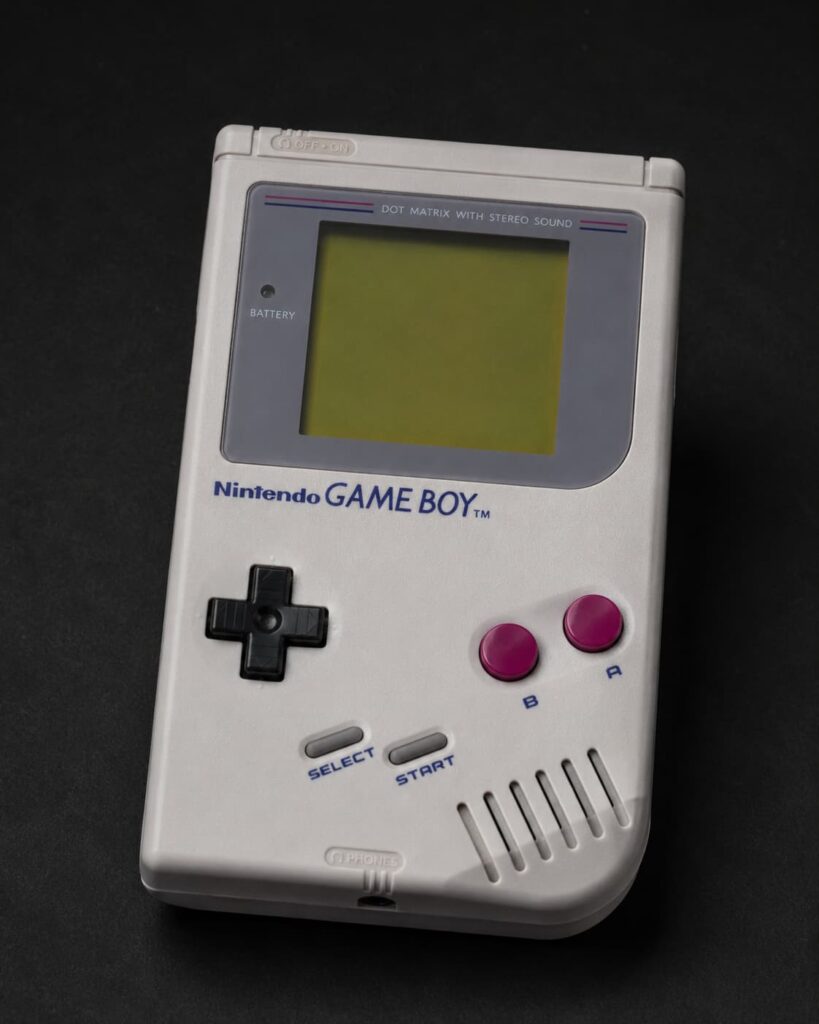
The original Game Boy — officially the DMG-01, nicknamed «Dot Matrix Game» — is the one most people picture when they close their eyes and think of a Game Boy. Grey shell, purple buttons, the Nintendo logo embossed into the top. It weighed 380 grams and took four AA batteries. The screen was 160×144 pixels and displayed everything in four shades of greenish-grey.
None of that should have worked. And yet.
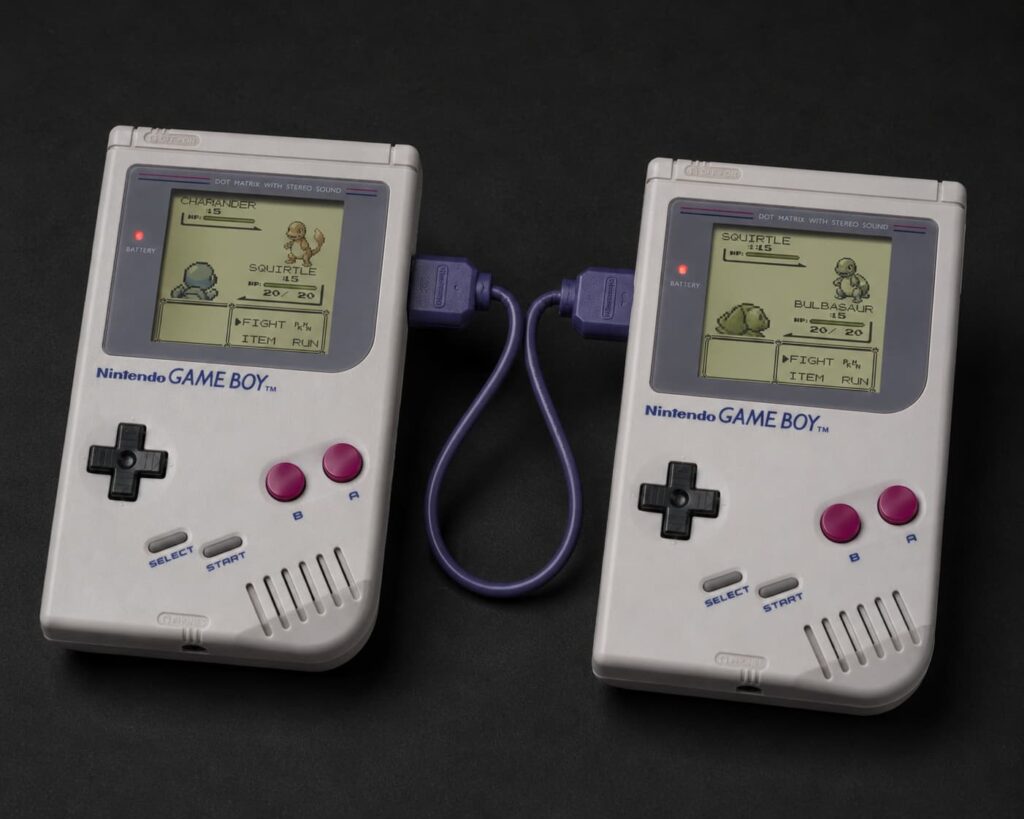
The library grew fast. Super Mario Land launched alongside the console. The Legend of Zelda: Link’s Awakening arrived in 1993 and stunned everyone who played it — a full Zelda experience, on this tiny machine, with no colour and a screen the size of a business card. Pokémon Red and Blue launched in Japan in 1996 and, combined with the Game Boy’s link cable, created something entirely new: a game that was fundamentally social, that required other people, that spread through schoolyards and playgrounds like nothing before it.
Pokémon and the Link Cable: Gaming Goes Social
It’s worth pausing on Pokémon, because it changed what the Game Boy was.
Before Pokémon, the link cable was a curiosity — useful for Tetris multiplayer, essential for a few fighting games, but mostly ignored. Pokémon made it the entire point. You couldn’t complete the Pokédex alone. You needed someone else. You needed the cable, and a friend, and a reason to talk to people you might not otherwise have talked to.
The Game Boy became a social object. Kids carried them to school not just to play, but to trade, to battle, to show off their team. It created communities before the internet made communities easy. It was peer-to-peer social networking, running on four AA batteries and a cable thicker than your thumb.
The Pocket, the Light, and the Color
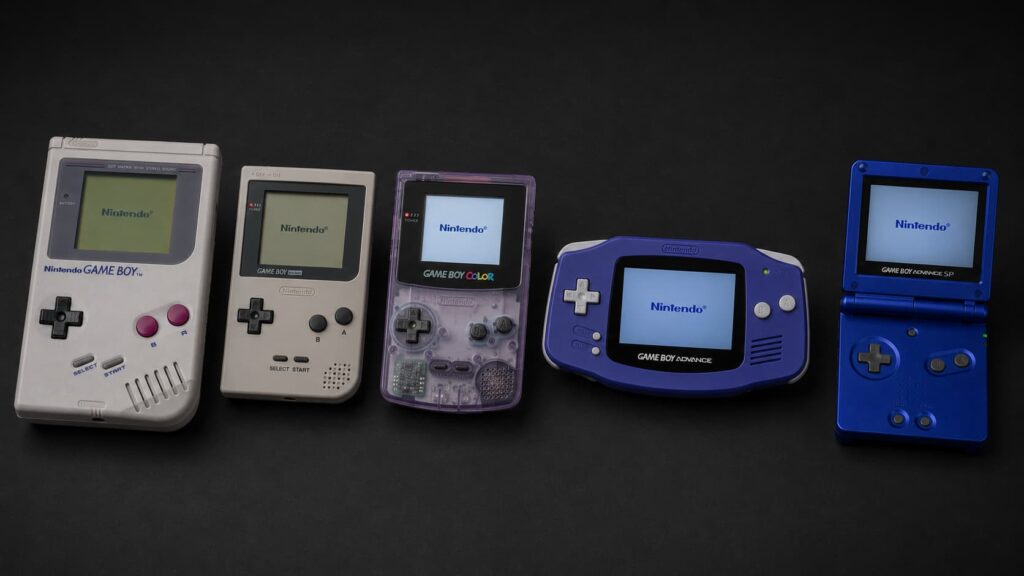
Nintendo spent most of the 1990s iterating. The Game Boy Pocket arrived in 1996 — slimmer, lighter, with a cleaner greyscale screen and a much more pocket-friendly form factor. The Game Boy Light followed in Japan in 1998, adding a backlight for the first time.
Then, in 1998, came the Game Boy Color.
The GBC kept the same basic form factor but added a proper colour screen and slightly faster processor. Crucially, it was fully backwards compatible with the original library — every Game Boy cartridge ever made still worked. This wasn’t just a product decision, it was a statement: Nintendo wasn’t asking you to start over. Everything you already had still mattered.
2001: The Game Boy Advance and the Reinvention
The Game Boy Advance, launched in 2001, was the biggest leap the line ever took. A landscape orientation instead of portrait. A 32-bit processor. A screen wide enough to feel cinematic by the standards of the time. Ports of Super Nintendo games that were genuinely faithful. New entries in the Pokémon series. Castlevania: Aria of Sorrow. Fire Emblem. Golden Sun.
The GBA was also the machine that established a template that would carry Nintendo through to the present day: powerful enough to be taken seriously, affordable enough to be accessible, built around software that no competitor could replicate.
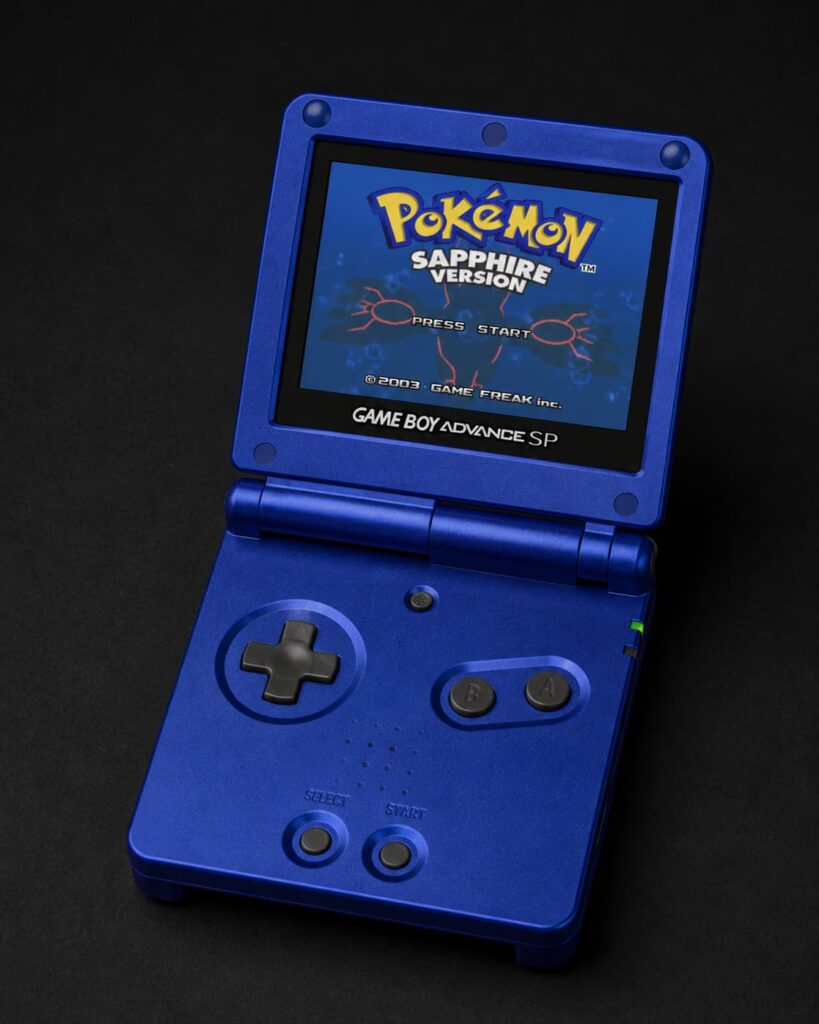
The Game Boy Advance SP followed in 2003, folding into a clamshell design with a backlit screen — finally, after 14 years, solving the darkness problem that had sent so many kids under the covers with a torch.
The Numbers
By the time production wound down, the Game Boy line had sold over 200 million units across all models. It dominated every market it entered. The original DMG-01 outlasted every competitor: the Game Gear, the Lynx, the Neo Geo Pocket, the Nomad. It survived being dropped, thrown, rained on, and — famously — hit by a bomb during the Gulf War. The display was destroyed. The machine still turned on. Nintendo put that unit in a display case at Nintendo’s headquarters and it stayed there for years.
Why It Won When It Shouldn’t Have
The conventional wisdom, then and now, is that better specs should win. The Game Gear had colour. The Lynx had a backlit screen. Both had more powerful hardware than the Game Boy.
Both were dead by the mid-90s.
Battery life killed the Game Gear — six AAs that lasted three to five hours versus the Game Boy’s thirty. Price killed the Lynx. But more than anything, games killed them both. Nintendo had Mario, Zelda, Metroid, Pokémon. They had relationships with third-party developers that no competitor could replicate overnight. They had a library.
Gunpei Yokoi’s philosophy was right: you don’t need the best hardware. You need hardware that’s good enough, at a price people can actually pay, running software that people actually want to play. Everything else is a spec sheet.
The Legacy: The DS, the Switch, and the Line That Never Ended
The Nintendo DS launched in 2004, and while it wasn’t called a Game Boy, it was a direct descendant. Dual screens, wireless connectivity, backwards compatibility with the GBA library. The DSi, the 3DS, the 2DS — the line continued, always portable, always focused on games over hardware.
The Nintendo Switch, launched in 2017, completed the circle: a home console you could take with you, a portable console you could plug into your TV. It’s the Game Boy idea taken to its logical conclusion. You play it on the train, you dock it when you get home. The portability isn’t a compromise. It’s the point.
The Game Boy never really ended. It just evolved.
The One in Your Drawer
There’s a good chance you still have one somewhere. In a box in a cupboard, at the back of a drawer, maybe in the original box if you were that kind of careful. Maybe the screen is scratched. Maybe the battery cover is missing and there’s a piece of cardboard holding the batteries in.
It still works.
That’s the thing about the Game Boy. It was built to last, by people who understood that the best technology is the technology you don’t have to think about. You just pick it up, and it takes you somewhere.
A lot of the world has changed since 1989. The grey brick endures.
❓ Frequently Asked Questions
When was the original Game Boy released?
The Game Boy launched in Japan on April 21, 1989, followed by North America in July 1989 and Europe in 1990.
Who invented the Game Boy?
The Game Boy was designed by Gunpei Yokoi, a legendary Nintendo engineer also responsible for the Game & Watch series and the NES D-pad controller.
How many Game Boys were sold?
Across all models — original DMG-01, Pocket, Color, Advance and Advance SP — the Game Boy line sold over 200 million units worldwide.
Why did the Game Boy beat the Sega Game Gear?
Primarily battery life (the Game Gear needed 6 AA batteries and lasted 3–5 hours versus the Game Boy’s 10–30 hours on 4 AAs), price, and library. Nintendo’s software catalogue — especially Pokémon — was impossible to compete with.
Is the original Game Boy compatible with Game Boy Color games?
Partially. Some GBC games run in a limited mode on the original hardware. GBC-exclusive titles require a Game Boy Color or later. The GBA is fully backwards compatible with both original GB and GBC cartridges.
Can you still buy a Game Boy?
New production stopped years ago, but original Game Boys are widely available on the used market in excellent condition. A growing retro-modding community also produces backlit screen upgrades, rechargeable battery kits and shell replacements.
🏁 Conclusion
The Game Boy story is about more than a piece of hardware. It’s about a design philosophy that prioritised the user over the spec sheet, a library that no competitor could match, and a game called Tetris that turned a children’s toy into something a generation of adults still can’t quite explain why they love so much.
It was the first screen that was entirely yours. No sharing with siblings, no negotiating for TV time, no waiting. Just you, a cartridge, and however long you had before the batteries ran out.
That feeling doesn’t go away. And if you’ve got a Game Boy sitting in a drawer somewhere, you already know that.
For more on the consoles, games and moments that shaped a generation, follow us at @analog.knights on Instagram — and explore the rest of the Memory Vault for the retro gaming gear worth tracking down today.