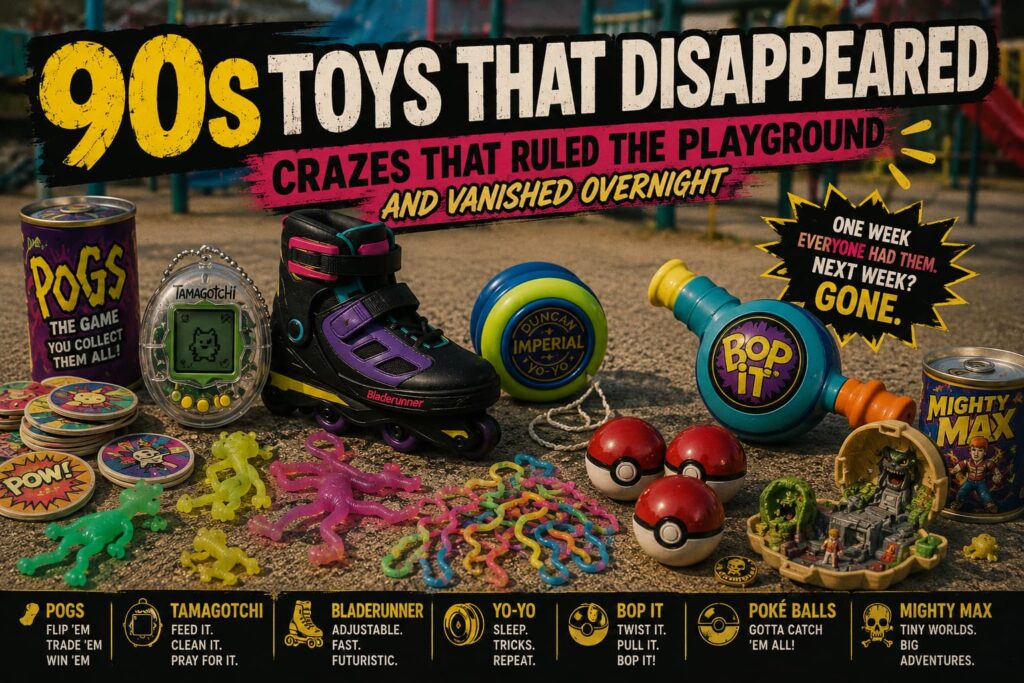
There was a specific rhythm to playground trends in the 90s. One Monday morning, one kid had something. By Friday, everyone did. By the following term, the teacher had confiscated half of them, the shops had sold out, and some parent somewhere had written a letter to a newspaper about it. And then — nothing. Gone. Replaced by the next thing, which followed the exact same cycle.
This is the story of the toys and crazes that burned the brightest and disappeared the fastest. The ones that ruled recess for a season and then vanished so completely that you can go years without thinking about them, and then one day something jogs the memory and you think: what actually happened to those?
🪙 POGs — The Game Nobody Fully Understood
If you grew up in the 90s and didn’t own a slammer, were you even there?
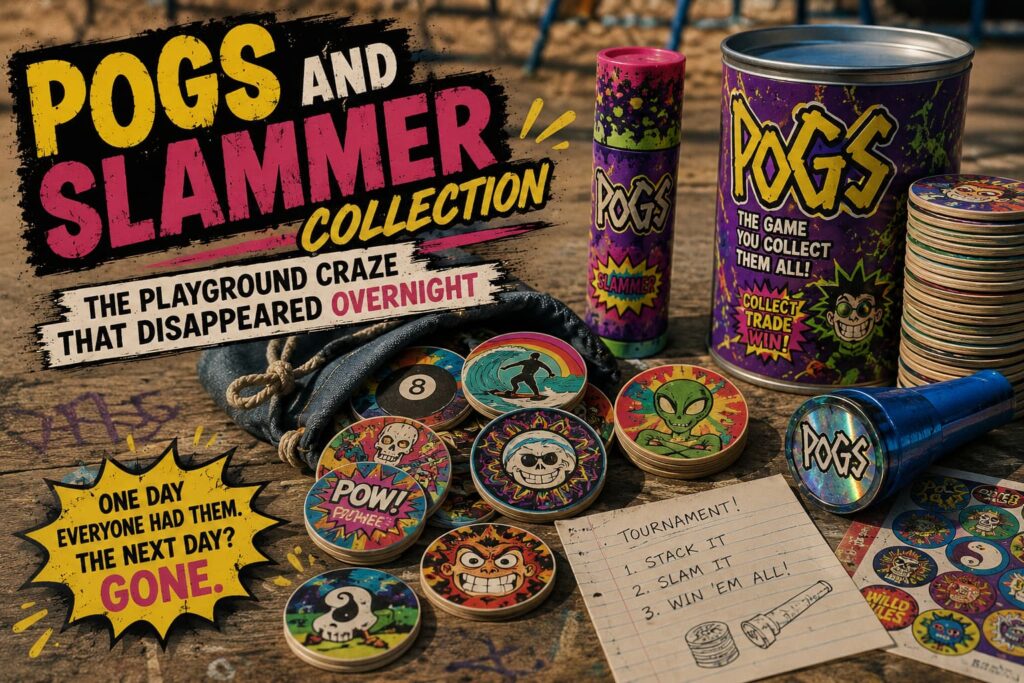
POGs — named after a Hawaiian juice drink whose bottle caps were the original playing pieces — spread through playgrounds in the early 90s with a speed that made no sense given that nobody could quite agree on the rules. The basic idea was straightforward enough: stack your POGs face down, take turns slamming the pile with a heavy disc, keep any that land face up. But in practice, every school had its own rules, every group had its own variations, and arguments about whether you were playing for keeps or just for fun were a constant source of conflict.
The slammer was the key piece. A thick, heavy disc — metal, rubber, or plastic — that you used to hit the stack. The rarer and heavier the slammer, the more status it conferred. Holographic slammers. Glow-in-the-dark slammers. The one kid in every year who had a metal slammer that was basically a weapon.
And then one day schools started banning them — partly because of the gambling element, partly because of the arguments, partly because teachers had simply had enough — and the craze collapsed almost overnight. Without the playground as a venue, POGs had nowhere to live. They disappeared into drawers and shoeboxes, and most of them are still there.
🐾 Tamagotchi — The Pet That Peaked and Panicked Everyone
The Tamagotchi didn’t just disappear — it was actively expelled.
Bandai’s virtual pet launched in 1996 and created a specific kind of anxiety that no toy before or since has quite replicated. The device beeped. It needed feeding. It needed cleaning. It could die. And it had absolutely no respect for the school timetable.
The beeping during lessons was what finished it. Teachers who had initially tolerated them — or perhaps not noticed them — reached a collective breaking point sometime in 1997, and the ban spread through schools with remarkable speed. The problem was that banning a Tamagotchi mid-cycle meant almost certain death for the creature inside, which created a new set of issues involving distressed children and increasingly irate parents.
What followed was a period of creative contraband smuggling that no other toy has ever inspired. Kids developed elaborate systems — leaving Tamagotchis with siblings at the school gate, asking dinner ladies to feed them, hiding them in PE bags and checking them between lessons. The lengths people went to were genuinely extraordinary for a device with a 32×16 pixel screen.
The craze faded by 1998 as the novelty wore off and the second wave of more complex virtual pets arrived. But the original Tamagotchi left something behind — a very specific emotional template for what it felt like to be responsible for something small and beeping and completely dependent on you.
🌀 Beyblades — When Spinning Tops Became a Lifestyle
Beyblades arrived in the early 2000s and immediately established themselves as the spiritual successor to POGs — a playground game with a competitive edge, a collecting component, and a very specific vocabulary that you either knew or you didn’t.
Let it rip. Two words that unlocked an entire subculture.
The genius of Beyblade was the modular design. Each top was made of interchangeable parts — the attack ring, the weight disc, the blade base — which meant that customisation and strategy were built in from the start. You didn’t just buy a Beyblade. You built one. You theorised about which combination would dominate in a battle. You lost sleep over whether your setup was optimal.
The beystadium — the arena — was the other key piece. A proper Beyblade battle needed a contained space, and the official stadiums gave the whole thing a sense of ritual and occasion. Without one, you were just spinning tops on the floor. With one, you were competing.
The ban arrived faster with Beyblades than it had with POGs, because the projectile risk was more obvious and more immediate. A Beyblade launched at full speed from an arena could travel a significant distance and cause a not-insignificant amount of pain. Schools were not wrong to be concerned. The kids didn’t care.
💜 Polly Pocket — An Entire World in Your Hand
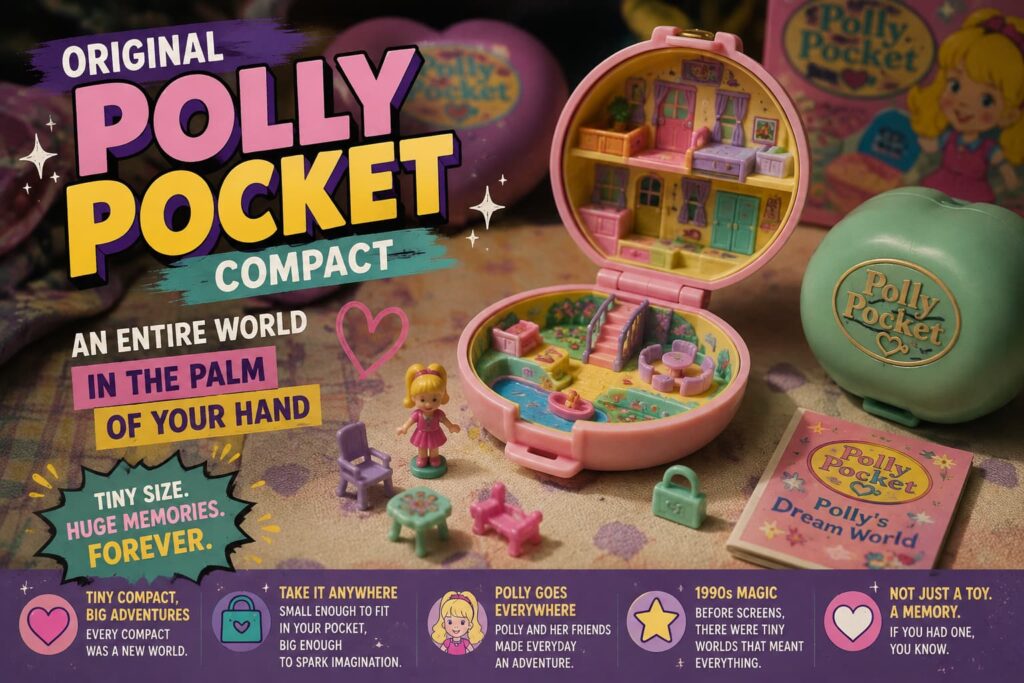
Polly Pocket occupied a different category to the others on this list. It wasn’t a craze with a competitive element or a social ritual. It was quieter than that — a toy that created a complete private world that you carried with you, that was entirely yours, that existed at a scale that felt somehow more intimate than a full-size playset.
The original Bluebird Toys Polly Pocket compacts — the ones from the late 80s through to the mid-90s, before Mattel bought the brand in 1998 and gradually scaled everything up — were miniature architectural achievements. A beach scene, a castle, a fairground, a mansion — all folded into a case the size of a large powder compact, with figures so small they could be lost in carpet pile and found again three years later behind a radiator.
What disappeared wasn’t the brand but the scale. When Mattel took over and made the figures larger and the playsets bigger, something was lost. The intimacy of the original format — the fact that the whole world fit in your pocket, that it was genuinely portable, that it was a secret — couldn’t survive at the new size. Polly Pocket continued. The thing that made it special didn’t.
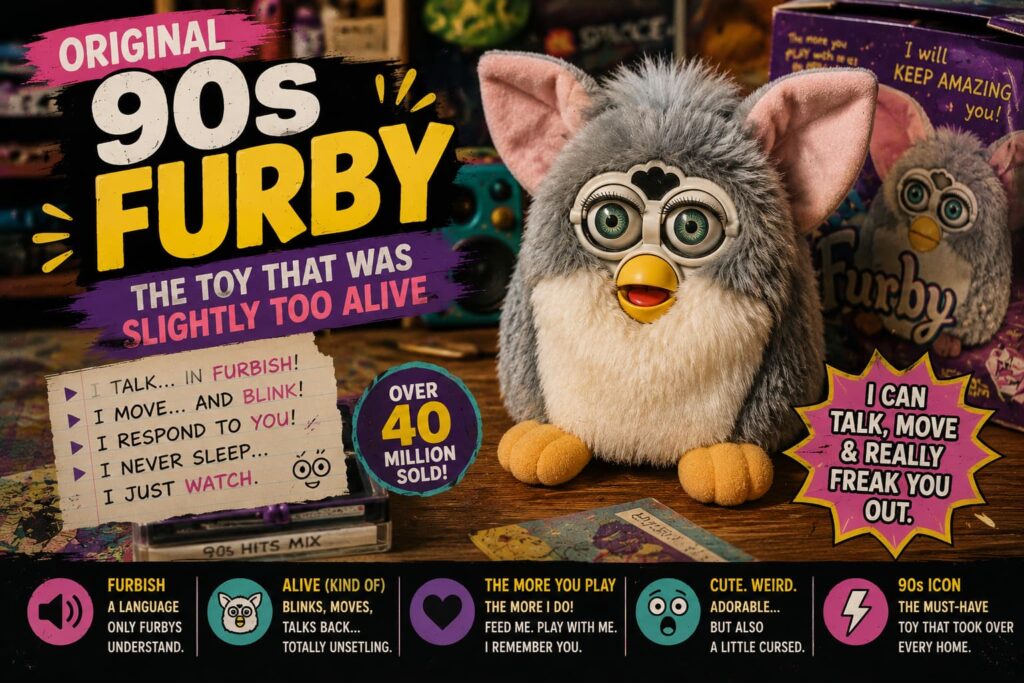
😱 Furbies — The Toy That Was Slightly Too Alive
The Furby problem was that it worked too well.
Tiger Electronics launched the Furby in 1998 and it was, by any commercial measure, an enormous success — one of the best-selling toys of the 1998 and 1999 holiday seasons, with over 40 million units sold in the first three years. But success and cultural persistence are different things, and the Furby achieved the former while actively undermining the latter.
The Furby was designed to seem alive. It had sensors that responded to touch, sound and light. It spoke its own language — Furbish — and gradually acquired English vocabulary over time, which was presented as learning but was actually just a timer. It had eyes that moved. It made sounds in the dark. It could, under the right circumstances, wake itself up unprompted.
This last feature was the problem. A Furby that activated itself in a darkened bedroom at 2am was not a toy. It was something else. The line between endearing and genuinely unsettling was one that Furby crossed regularly and without warning, and this — more than any ban, more than any competing craze — is what ended its cultural moment. People started putting them in cupboards. Then in bins. Then the bins went out and the Furbies went with them.
🃏 Pokémon Cards — The One That Never Actually Left
Pokémon deserves a special mention because it almost follows the same pattern — the explosive arrival, the school ban, the playground economics, the parental bewilderment — but with a crucial difference: it never fully disappeared.
The first wave hit in 1999. Cards were being traded, stolen, argued over and confiscated at a rate that school administration was genuinely unprepared for. The ban came quickly. The underground economy continued regardless.
But unlike POGs, which had no identity beyond the playground game, Pokémon had an anime, a game, a mythology, an expanding world that kept generating new reasons to stay interested. The cards were one component of something larger. When the ban pushed them out of school, they didn’t disappear — they just moved into bedrooms and living rooms and eventually online.
The generation that grew up with the first wave is now in their 30s. They’re buying booster packs again. They’re introducing their own children to it. The cards that got confiscated in 1999 are now worth money. Pokémon didn’t disappear. It just went quiet for a while and came back stronger.
What They Had in Common
Looking back at these toys as a group, a pattern emerges that wasn’t visible at the time.
The ones that disappeared fastest were the ones whose entire value was social — POGs needed a playground to exist. Beyblades needed a stadium and an opponent. Without the school context, they had no reason to exist. The ban didn’t just remove them from school. It removed the entire environment that gave them meaning.
The ones that survived in some form were the ones with something beyond the social moment. Tamagotchi had an emotional hook — the specific anxiety of responsibility — that could exist in private. Polly Pocket created a world that was yours alone, independent of other people. Pokémon had a mythology. These things gave the toys somewhere to go when the playground wasn’t available.
The lesson — if playground toy crazes have lessons — is that the toys which last are the ones that mean something when you’re alone with them, not just when you’re surrounded by other people who have the same thing. The social moment launches them. Something else makes them stay.
🛒 Some of These Actually Came Back
The good news: a few of these aren’t entirely gone.
These are affiliate links — if you buy something we may earn a small commission at no extra cost to you.
🐣 Tamagotchi Original Reissue — Bandai brought the original back, running the actual 1996 software. Same three buttons, same specific anxiety, same beeping at inconvenient moments.
Check Price →
🌀 Beyblade Burst Spinning Top Set — The modern version keeps the core mechanic intact. Modular parts, proper battles, the same launch technique you spent weeks perfecting.
Check Price →
👜 Polly Pocket Compact Playset — The compact format is back. Not quite at the original miniature scale, but closer than it’s been in years. Still clicks shut satisfyingly.
Check Price →
⚡ Pokémon TCG Elite Trainer Box — The one that never left. Open a pack with someone who’s never done it before and watch their face when the holographic card catches the light.
Check Price →
❓ Frequently Asked Questions
Why did 90s toy crazes disappear so fast?
Most 90s toy crazes were fundamentally social — their value came from other people having the same thing. When schools banned them, they lost the primary environment where that social value existed. Without the playground, they had nowhere to live.
Are POGs worth anything today?
Common POGs have minimal monetary value — they were produced in enormous quantities. Rare slammers, limited edition sets and unopened tubes in good condition can command a premium among collectors, but most childhood POG collections are worth more as memories than as objects.
Why did Furby disappear?
The original Furby’s combination of unpredictable behaviour, motion-activated responses and tendency to activate in the dark made it genuinely unsettling to live with long-term. The novelty of the «learning» element faded quickly once people realised it was a timer rather than genuine adaptation. Mattel has relaunched Furby several times since, with mixed results.
Did any 90s toy crazes last?
Pokémon is the clearest example of a 90s craze that genuinely persisted — sustained by an expanding media franchise that gave each new generation a reason to engage. Tamagotchi and Beyblade have both had successful relaunches. Most others remain firmly in nostalgia territory rather than active culture.
What was the biggest 90s toy craze?
Commercially, Tamagotchi and Furby both sold tens of millions of units in their peak years. Culturally, the Pokémon card craze arguably had the deepest impact — it changed how schools thought about trading card games and created an economic ecosystem among children that parents and teachers found genuinely alarming.
🏁 One Last Thing
The toys that disappeared weren’t failures. They were exactly what they were supposed to be — intense, social, short-lived and completely consuming while they lasted. The playground doesn’t need permanence. It needs the thing that everyone’s talking about right now, for exactly as long as everyone’s talking about it.
The Furby in the cupboard. The POGs in the shoebox. The Beyblade at the back of the wardrobe. They’re still there somewhere, in most houses that had children in the 90s. Not valuable. Not forgotten either.
Just waiting for someone to open the drawer.
For more memories like this, come find us at @analog.knights on Instagram. And if the nostalgia is hitting hard today, the Memory Vault has the stuff worth actually tracking down.