The Betrayal That Created PlayStation — Nintendo, Sony and the Deal That Changed Gaming Forever
The most important moment in the history of video games didn’t happen in a game. It happened on a stage, in front of an audience, in the summer of 1991 — and it was an act of corporate humiliation so complete, so deliberate and so public that it set in motion a chain of events that reshaped the entire industry.
Nintendo betrayed Sony. Sony built PlayStation in response. And nothing was ever the same.
This is the story of how it happened.
The Partnership That Was Supposed to Change Everything
To understand the betrayal, you have to understand the deal.
In the late 1980s, Nintendo was the undisputed king of the video game industry. The NES had rescued the American market from the crash of 1983 and the Super Nintendo was on its way. But Nintendo’s leadership — particularly its CEO Hiroshi Yamauchi — was already thinking about the next generation of hardware. Specifically, about CD-ROM technology, which offered vastly more storage than cartridges and the possibility of full audio, video and a completely different kind of gaming experience.
Nintendo needed a partner with expertise in audio technology and CD manufacturing. Sony, at that point, was one of the most respected electronics companies in the world and had pioneered the CD format. The partnership made obvious sense.
The two companies entered negotiations and eventually reached an agreement. Sony would develop a CD-ROM add-on for the Super Nintendo — known internally as the SNES-CD — and also a standalone console that could play both SNES cartridges and the new CD format. The standalone device would be called the Play Station.
Ken Kutaragi, a Sony engineer who had already quietly helped Nintendo develop the SNES sound chip, was the driving force on Sony’s side. He believed in the project completely. Sony’s leadership was more cautious, but the deal was signed, the development work began, and both companies proceeded on the assumption that they were building something together.
E3 1991: The Most Public Humiliation in Business History
The Consumer Electronics Show in Chicago, June 1991.
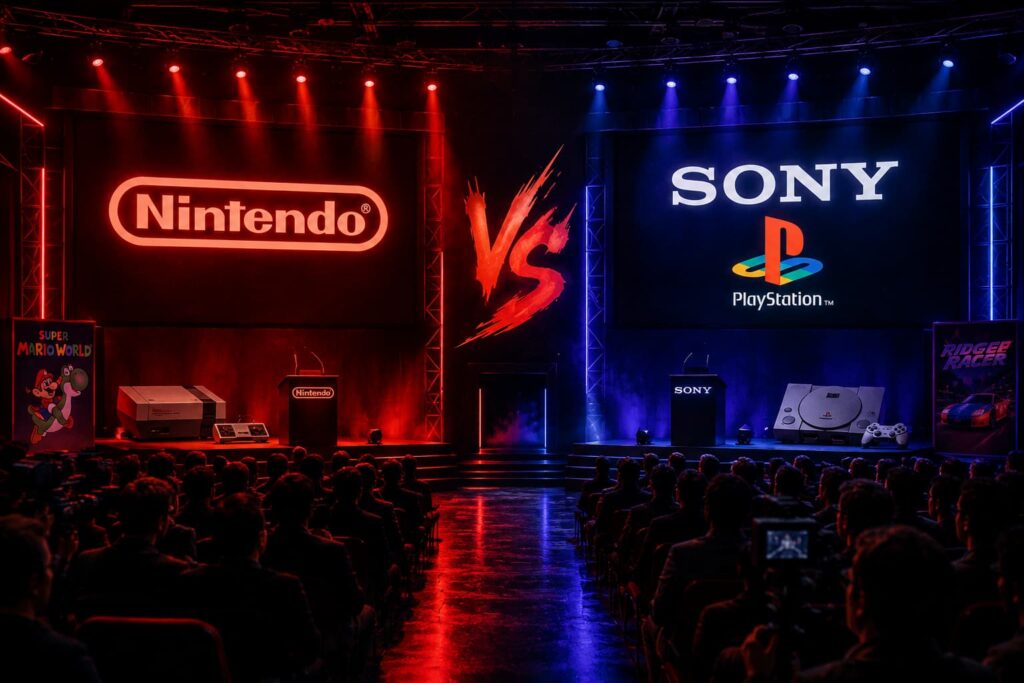
Sony took the stage on the first day of the show and made the announcement. The Play Station was coming. Sony and Nintendo were partners. The future of gaming was CD-ROM. The audience received it well. Everything seemed to be proceeding as planned.
The next morning, Nintendo took the stage.
What happened next has become one of the most retold stories in gaming history, but it bears retelling because the details matter. Nintendo announced, to the complete surprise of everyone in the room — including the Sony executives who were present — that they had formed a partnership with Philips to develop a CD-ROM add-on for the Super Nintendo. Not Sony. Philips.
In a single announcement, Nintendo had publicly invalidated everything Sony had said the day before. The partnership was over. The Play Station was dead. And Sony had been informed of this not in private, through the normal channels of business negotiation, but in front of the entire industry, on stage, in the most humiliating way imaginable.
The reasons for Nintendo’s decision have been debated ever since. The most widely accepted explanation is that Yamauchi had become concerned about the contract terms — specifically, that Sony retained too much control over software licensing for the CD format, which would have given them significant power over Nintendo’s own platform. Other accounts suggest personal friction between the companies’ leadership. Whatever the precise cause, the decision was final, and the manner of its delivery was unmistakably deliberate.
Sony’s Response: Rage, Then Resolve
The immediate reaction at Sony was, by all accounts, somewhere between fury and humiliation. Senior executives wanted to walk away from the gaming industry entirely. The investment in the Play Station project had been significant, the public embarrassment was enormous, and the obvious response was to cut losses and move on.
Ken Kutaragi had a different view.
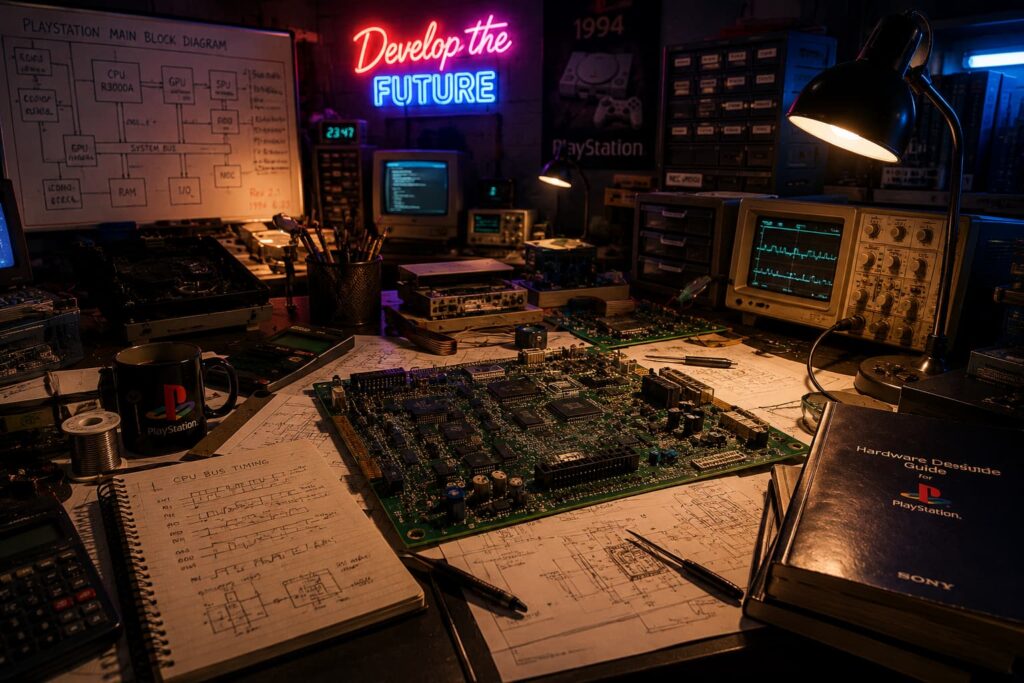
Kutaragi argued that Sony should not abandon the project but transform it. Instead of building hardware for Nintendo’s platform, Sony should build its own platform. A standalone console with CD-ROM as its native format, designed from the ground up, controlled entirely by Sony. No Nintendo. No compromises. No licensing arrangement that left Sony subordinate to another company’s decisions.
The argument was not immediately persuasive. Sony’s leadership was a consumer electronics company, not a gaming company. They knew how to make televisions and Walkmans, not consoles. The gaming market was dominated by Nintendo and Sega. The risks were enormous.
But Kutaragi was persistent, and he had an ally in Norio Ohga, Sony’s CEO, who had been personally present at the CES humiliation and had not forgotten it. Ohga gave Kutaragi approval to proceed. A small team began development work. The project that would become PlayStation was underway.
Building the Machine
The development of the original PlayStation took roughly four years — from the decision to proceed in late 1991 to the Japanese launch in December 1994.
The technical specifications Kutaragi’s team settled on were ambitious for the time. A 32-bit processor at a point when most of the market was still 16-bit. CD-ROM as the primary format. A dedicated graphics processing unit capable of rendering 3D polygons at a quality that nothing else on the market could match. And a price point — ¥39,800 in Japan, $299 in the United States — that was aggressive enough to be genuinely competitive.
The 3D capability was the key decision. Kutaragi and his team had looked at where gaming was going and concluded that the future was three-dimensional. The move from 2D sprites to 3D polygons was the transition that would define the next generation, and they designed their hardware specifically to be exceptional at it.
They were right about this in a way that neither Nintendo nor Sega fully appreciated at the time. The Nintendo 64, when it eventually launched in 1996, was also a 3D-capable machine — but it launched two years after PlayStation, used cartridges instead of CDs, and cost more. Sega’s Saturn launched in the same period as PlayStation but its architecture was poorly suited to 3D graphics and its price was higher.
The field was clearer than it might have looked from the outside.
December 3, 1994: Launch Day in Japan
The PlayStation launched in Japan on December 3, 1994. It sold 100,000 units on the first day. Within ten days, it had sold 300,000. By the end of 1994, Sony had sold over 500,000 units in Japan alone.
The launch library was not enormous — around fifteen titles — but it contained Ridge Racer, which demonstrated the 3D capability of the hardware in a way that was genuinely arresting. People gathered around displays in shops not to play the game but simply to watch it run.
The North American launch followed in September 1995, at $299, alongside a legendary marketing campaign that positioned PlayStation not as a children’s toy but as a machine for a slightly older, cooler, more sophisticated audience than Nintendo was targeting. The advertising was deliberately edgy. The brand identity was urban, young, and decidedly not family-friendly in the Nintendo sense.
It worked. PlayStation sold 800,000 units in its first month in North America. By the end of 1995 it had sold more than a million. By the end of 1996 it had overtaken both Nintendo’s SNES and Sega’s Saturn in cumulative sales.
The Games That Proved the Point
Hardware is only as good as its software, and what PlayStation accumulated over its lifetime was one of the greatest game libraries in the history of the medium.
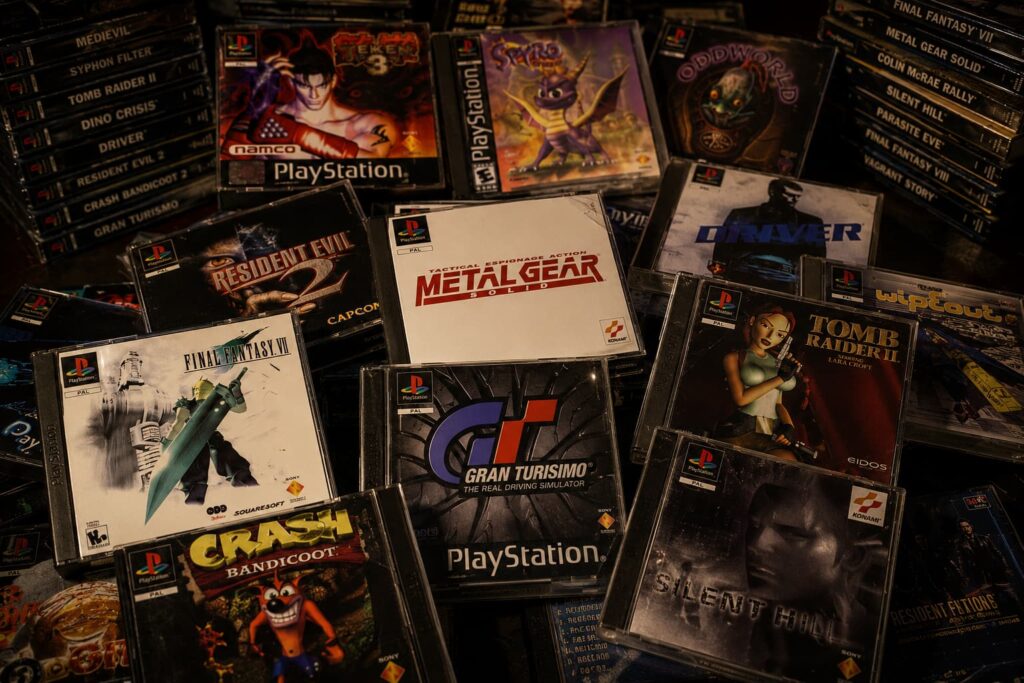
Tekken. Ridge Racer. Wipeout. Crash Bandicoot. Final Fantasy VII. Metal Gear Solid. Resident Evil. Tomb Raider. Gran Turismo. Castlevania: Symphony of the Night. Tony Hawk’s Pro Skater. Spyro the Dragon.
Each of these was, in different ways, a demonstration of what the machine could do and what gaming could be. Final Fantasy VII in particular — released in 1997 in Japan, 1997 in North America and 1997 in Europe — was a cultural event of a scale the industry had not seen before. It introduced millions of people to Japanese role-playing games and proved that the medium could carry genuine emotional weight.
Metal Gear Solid, in 1998, demonstrated that a video game could function as a piece of narrative cinema — with voice acting, cutscenes, a complex plot and a director, Hideo Kojima, who thought of himself as a filmmaker as much as a game designer.
Crash Bandicoot, developed by Naughty Dog and published by Sony, became the unofficial mascot of the platform and one of the best-selling games of the generation. It was fast, colourful, technically remarkable and — crucially — it gave PlayStation a character as recognisable as Mario or Sonic.
What Happened to Nintendo
Nintendo was not destroyed by PlayStation. It would be wrong to suggest otherwise. The Nintendo 64 sold 33 million units and had landmark titles of its own — Super Mario 64, The Legend of Zelda: Ocarina of Time, GoldenEye 007 — that are among the finest games ever made.
But the balance of power had shifted, and it never fully shifted back.
PlayStation sold over 102 million units in its lifetime. PlayStation 2, which launched in 2000, sold over 155 million — the best-selling console of all time until it was eventually surpassed by the Nintendo DS. Sony had gone from having no presence in the gaming market in 1991 to being its dominant force within a decade.
Nintendo’s decision to stay with cartridges for the N64 — partly out of concern about loading times, partly because cartridges were harder to pirate and offered better licensing control — proved costly. Third-party developers, who were producing games with increasingly large file sizes, migrated to PlayStation where CD-ROMs offered the storage they needed. Square, the company behind Final Fantasy, had been a loyal Nintendo partner. Final Fantasy VII was originally planned for the N64. When it became clear that the game’s scope required more storage than a cartridge could provide, Square moved it to PlayStation. The game sold over 13 million copies. Nintendo lost one of the most important game series in the industry.
The irony was complete: Nintendo’s attempt to maintain control over its platform had, via the chain of events it set in motion in 1991, handed that control to Sony.
The Legacy
Ken Kutaragi retired from Sony in 2007, having overseen the development of PlayStation, PlayStation 2 and PlayStation 3. He is known, with complete justification, as the Father of PlayStation.
The console he built in response to humiliation went on to define a generation of gaming and a generation of players. The teenagers who sat in front of a PlayStation in 1995 are now in their late 30s and early 40s. Many of them are still gaming. Some of them are making games. The experiences they had — the first time they heard the PS1 startup sound, the first time they watched a Final Fantasy VII cutscene, the first time the twist in Metal Gear Solid landed — are part of the furniture of their memory.
None of it would have existed if Nintendo had honoured its agreement with Sony.
The best things in the games industry, it turns out, sometimes come from the worst moments in the games industry.
🛒 Still Playing: The Best of That Era, Available Today
The games and hardware that defined PlayStation’s golden age are more accessible than ever.
These are affiliate links — if you buy something we may earn a small commission at no extra cost to you.
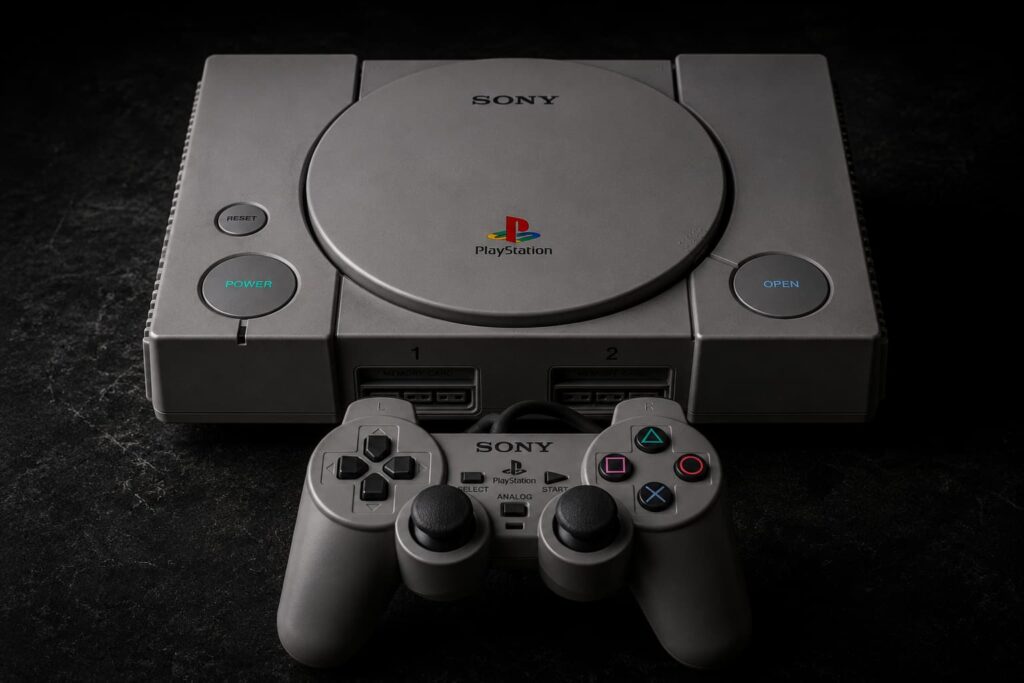
🎮 PlayStation Classic Mini Console — Sony’s official miniature recreation of the original PS1, preloaded with 20 games including Resident Evil Director’s Cut, Metal Gear Solid, Tekken 3 and Final Fantasy VII. The startup sequence, the original controller, the memory card slots — all intact.
Check Price →
🦊 Crash Bandicoot N. Sane Trilogy — All three original Crash games rebuilt for modern consoles with faithful visuals and the exact same level design. Still harder than you remember. Still completely absorbing.
Check Price →
🛹 Tony Hawk’s Pro Skater 3 + 4 — The skating game that defined the PS1/PS2 era remastered for PS5. Two minutes on the clock. The soundtrack intact. The muscle memory comes back immediately.
Check Price →
🎮 Retro-Bit Origin Wireless Controller — A wireless controller styled after the classic pad layout. Works with Switch, PC and Android. The right weight, the right button feel, the right amount of nostalgia.
Check Price →
❓ Frequently Asked Questions
Why did Nintendo betray Sony?
The most widely accepted explanation is that Nintendo’s CEO Hiroshi Yamauchi was concerned about the contract terms — specifically that Sony retained control over software licensing for the CD format, which would have given them significant power over Nintendo’s platform. The manner of the announcement, however — done publicly at CES rather than through private negotiation — suggested a deliberate act of humiliation rather than a straightforward business decision.
Who is Ken Kutaragi?
Ken Kutaragi is the Sony engineer who led the development of the original PlayStation and its successors. Known as the Father of PlayStation, he had previously and quietly helped Nintendo develop the sound chip for the Super Nintendo — making his eventual role in building Sony’s competing platform one of the more ironic footnotes in gaming history.
What games came with the PlayStation Classic?
The PlayStation Classic comes preloaded with 20 games including Final Fantasy VII, Metal Gear Solid, Resident Evil Director’s Cut, Tekken 3, Grand Theft Auto, Oddworld: Abe’s Oddysee, Jumping Flash, Mr. Driller, Rayman, Ridge Racer Type 4, Syphon Filter, Tom Clancy’s Rainbow Six, Twisted Metal, Wild Arms and others.
Did Sony and Nintendo ever work together again?
Their relationship remained distant for many years after the 1991 split. Nintendo and Sony have occasionally appeared at the same industry events and have expressed mutual respect in interviews, but the two companies have been competitors rather than partners ever since. The Philips deal that Nintendo announced in Sony’s place largely failed — the resulting CD-i games based on Nintendo properties are generally considered among the worst games ever made.
How many units did the original PlayStation sell?
The original PlayStation sold over 102 million units worldwide over its lifetime, making it one of the best-selling consoles ever made at the time of its discontinuation. Its successor, the PlayStation 2, went on to sell over 155 million units — the best-selling console of all time until recently surpassed.
🏁 One Last Thing
The startup sequence. The grey disc spinning up. The crystalline chime of the PS1 boot screen.
If you grew up with a PlayStation, that sound is somewhere in your nervous system right now — not as a memory exactly, more as a physical sensation. The anticipation of what was about to load. The specific quality of the silence before the game began.
Ken Kutaragi’s team designed that startup sequence deliberately. They wanted something that felt cinematic, that signalled to the player that what was about to happen was significant. They wanted it to feel like the lights going down in a cinema.
It worked. It still works. Thirty years later, there are people all over the world who hear that sound and feel something that doesn’t have a precise name — something between nostalgia and excitement and the particular sweetness of a memory that hasn’t faded at all.
That’s the sound Nintendo accidentally made possible.
For more on the consoles and moments that shaped a generation, find us at @analog.knights on Instagram. And for the retro gaming gear worth tracking down today, the Memory Vault has everything we’d actually buy.